


Chronic low back pain is rarely caused by only one thing. Disc degeneration, arthritis, spinal stenosis, prior injuries, work demands, sleep, stress, and deconditioning can all contribute. But for many people, obesity is more than a condition that happens to exist alongside back pain. It can actively drive it.
Excess body weight, especially abdominal or visceral fat, changes how the spine is loaded, how muscles work, and how the body regulates inflammation. Over time, these changes can contribute to disc degeneration, back stiffness, reduced walking tolerance, and persistent pain.
That does not mean every person with back pain needs to “just lose weight,” nor does it mean weight loss replaces a careful diagnosis or appropriate treatment. A disc herniation, fracture, severe stenosis, infection, cancer, or progressive neurologic deficit still deserves prompt medical evaluation. But when excess weight is adding mechanical and inflammatory stress to the spine, weight management becomes a meaningful part of a complete back-pain plan.
At Horizon Spine & Pain of Utah, we help patients in Payson, Provo, Spanish Fork, Salem, Lehi, and throughout Utah County address both the pain generator and the factors that may be keeping pain active.
Obesity Is Linked to More Frequent and More Severe Back Pain
Research consistently shows a dose-response relationship: as body weight rises, the likelihood, severity, and persistence of low back pain rise with it.
Large studies have found that people with overweight or obesity have roughly 1.4 times the likelihood of chronic low back pain compared with people at a healthy weight. A recent JAMA review also identified obesity as an established risk factor for low back pain, with an odds ratio of approximately 1.5.[1,2]
The relationship is not limited to BMI. Measures of central obesity—such as waist circumference and waist-to-height ratio—may be particularly relevant. In other words, abdominal fat appears to matter because it affects both spinal mechanics and whole-body inflammation.[3,4]
Genetic and Mendelian-randomization studies also support the possibility that higher body weight is a cause of back pain in at least some patients, rather than simply a result of becoming less active because of pain.[5,6]
How Excess Weight Can Drive Back Pain
1. More Mechanical Stress on the Lumbar Spine
The lumbar spine supports body weight with every step, sit-to-stand movement, lift, and prolonged standing task. Extra weight increases the load on discs, facet joints, sacroiliac joints, and paraspinal muscles. Abdominal weight can also shift the body’s center of mass forward, increasing the work required of the lumbar extensor muscles.
Over time, this may contribute to muscle fatigue, altered movement patterns, disc stress, and pain with standing, walking, bending, or transitional movements.
2. Inflammation Can Affect Discs and Joints
Fat tissue is metabolically active. Visceral fat can release inflammatory signals, including TNF-alpha, IL-6, IL-1 beta, leptin, and other adipokines. These signals may contribute to low-grade systemic inflammation and may also influence intervertebral-disc degeneration through inflammatory and matrix-degrading pathways.[7]
This matters because a painful disc is not always only a mechanical problem. Inflammation, endplate changes, insulin resistance, and metabolic dysfunction may all contribute to the environment in which discs and joints break down.
3. Metabolic Disease Can Compound the Problem
Insulin resistance, diabetes, poor sleep, depression, inactivity, and low cardiovascular fitness are common in patients with obesity and chronic pain. They do not explain every case of back pain, but they can lower pain tolerance, interfere with recovery, increase inflammation, and make it harder to rebuild strength after an injury or procedure.
4. Pain and Weight Gain Can Reinforce Each Other
Back pain makes exercise harder. Less activity can lead to loss of conditioning, weight gain, and more pain with movement. The goal is to interrupt that cycle without demanding that someone “push through” severe pain or start with an unrealistic workout plan.
Does Weight Loss Actually Improve Low Back Pain?
The honest answer is that the evidence is promising but still incomplete.
Weight loss is biologically sensible for many patients with chronic low back pain, and obesity clearly tracks with a greater burden of pain. However, high-quality trials proving that weight loss alone reliably improves low back pain are still limited. A recent Cochrane review highlighted this evidence gap.[8]
That does not make weight management unimportant. It means we should present it accurately: weight loss may reduce spinal loading, improve exercise tolerance, help sleep and metabolic health, and make rehabilitation more achievable. It should be part of a broader plan rather than marketed as a guaranteed cure.
Can GLP-1 Medications Help With Back Pain?
GLP-1–based medications, including semaglutide and tirzepatide, are effective treatments for obesity when prescribed appropriately as part of a medically supervised plan. They are not FDA-approved specifically to treat back pain. Their role is to treat obesity and related metabolic disease; any back-pain benefit is expected to come primarily through weight loss, better mobility, and possibly lower systemic inflammation.
There is encouraging evidence in other musculoskeletal conditions. In the STEP 9 randomized trial of adults with obesity and painful knee osteoarthritis, semaglutide 2.4 mg weekly produced greater weight loss, improved physical function, and greater reduction in knee pain than placebo over 68 weeks.[9]
For low back pain specifically, there is not yet a dedicated randomized trial showing that GLP-1 therapy treats chronic low back pain. A large retrospective cohort study did find that GLP-1 receptor agonist use was associated with lower rates of thoracolumbar disc disease, cervical disc degeneration, osteoarthritis, osteoporosis, and fracture compared with other anti-obesity medications. This is encouraging, but it does not prove that GLP-1 treatment prevents or cures back pain.[10]
For the right patient, GLP-1 treatment can be a useful starting point because it may make exercise, physical therapy, and sustainable nutrition changes more achievable. It is not a substitute for a spine evaluation, rehabilitation plan, or treatment of a specific painful condition such as stenosis, radiculopathy, sacroiliac dysfunction, vertebrogenic pain, or a disc herniation.
Who May Be a Good Candidate for Medical Weight Loss?
Medical weight-loss treatment may be worth discussing for adults with:
- A BMI of 30 or greater
- A BMI of 27 or greater plus a weight-related medical condition, such as hypertension, prediabetes, diabetes, sleep apnea, or dyslipidemia
- Chronic back pain that is limiting exercise and contributing to further weight gain
- A history of repeated dieting without sustainable weight loss
- A desire to improve mobility, conditioning, and long-term spine health
Medication choice should be individualized. GLP-1 medications can cause nausea, vomiting, constipation, diarrhea, and other side effects. They also have important contraindications and require screening for medical history, other medications, nutritional needs, and pregnancy considerations when applicable.
Physical Therapy Helps—But Graded Exercise Is Where the Long-Term Change Happens
Physical therapy is often the best place to start, particularly when pain is severe, there has been prior surgery, or movement feels unsafe. A skilled therapist can identify movement restrictions, teach safer lifting and bending strategies, build hip and core strength, and help patients regain confidence.
But the long-term goal is not simply to attend therapy. It is to build a sustainable exercise habit that continues after formal therapy ends.
A good plan is graduated: start below the level that causes a major flare, repeat it consistently, and slowly build capacity.
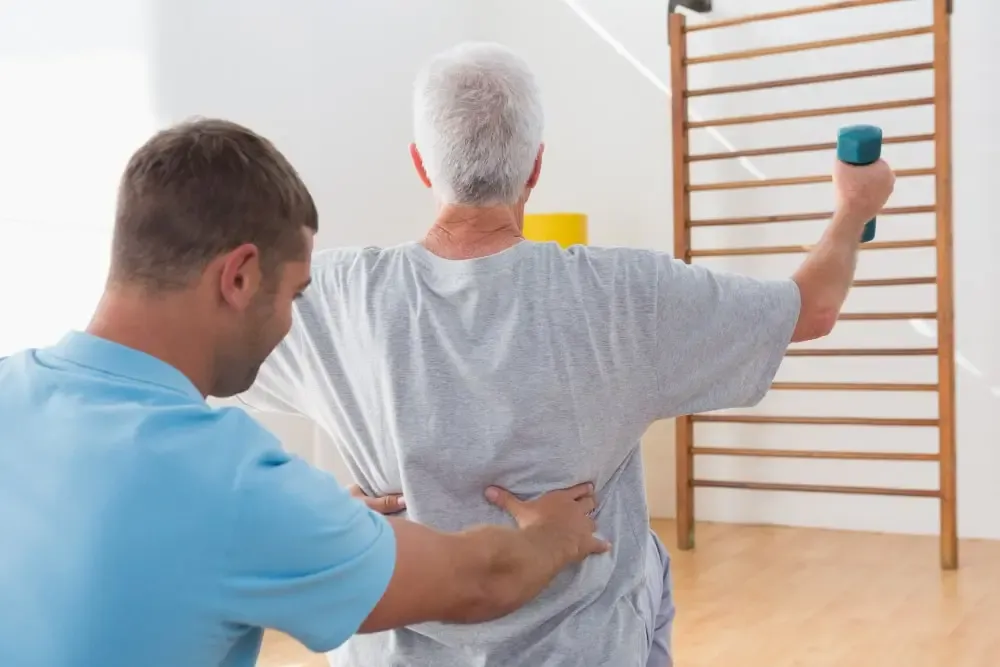
Phase 1: Restore Movement Confidence
For the first two to four weeks, focus on daily movement that is tolerable:
- Five to 10 minutes of walking, recumbent biking, pool walking, or another low-impact activity most days
- Gentle lumbar, hip, and hamstring mobility
- Basic core activation, such as abdominal bracing, bridges, bird-dogs, or modified dead bugs when appropriate
- Brief movement breaks during prolonged sitting or standing
The goal is consistency, not intensity. A short walk performed most days is more useful than one difficult workout followed by a week-long pain flare.
Phase 2: Build Strength and Aerobic Capacity
As tolerance improves, gradually increase total activity:
- Add a few minutes of aerobic activity each week
- Work toward 150 minutes of moderate-intensity activity per week as tolerated
- Add resistance training two days per week
- Prioritize glutes, legs, trunk endurance, posture, and pulling movements
- Use water exercise, cycling, elliptical training, or incline walking when impact is poorly tolerated
A simple rule: increase one variable at a time—duration, resistance, or frequency—not all three in the same week.
Phase 3: Protect the Results
Once pain and conditioning improve, keep the program practical:
- Continue strength training two to three times weekly
- Maintain regular low-impact cardiovascular exercise
- Use walking, stairs, household activity, and active recreation to reduce long periods of sitting
- Continue nutrition changes that support gradual, sustainable weight loss
- Return to physical therapy for a tune-up if a flare disrupts progress
A Better Goal Than “Just Lose Weight”
For many patients, a useful initial target is not a perfect number on the scale. It is improved function:
- Walk farther with less pain
- Stand longer at work
- Sleep with fewer pain interruptions
- Use fewer rescue medications
- Keep up with children or grandchildren
- Return to exercise without a major flare
- Reduce the frequency and duration of bad pain days
Even modest weight loss combined with better conditioning can improve movement confidence and reduce mechanical stress. Larger weight loss may produce larger health benefits, but the most durable plan is the one a patient can maintain.
When Back Pain Needs More Than Weight Loss and Exercise
Weight management and exercise do not replace medical evaluation. Patients should be assessed promptly for progressive weakness, new bowel or bladder dysfunction, saddle numbness, fever, unexplained weight loss, major trauma, suspected fracture, cancer-related pain, or severe unrelenting pain.
Many patients benefit from a combined plan that may include physical therapy, medication optimization, image-guided injections, radiofrequency ablation, basivertebral nerve ablation, spinal cord stimulation, surgical consultation, or other targeted treatment. The right intervention depends on the actual pain generator.
Chronic Back Pain Treatment in Utah County
If chronic low back pain has made weight loss and exercise feel impossible, the answer is not to give up or wait until pain is “bad enough.” A thoughtful plan can address pain control, movement, conditioning, sleep, and weight together.
Horizon Spine & Pain of Utah serves patients in Payson, Spanish Fork, Salem, Provo, Orem, Lehi, and throughout Utah County. We evaluate the source of back pain, use evidence-based interventional options when appropriate, and help patients build a realistic pathway back to activity.
Pain Relief Is On The Horizon — Driven by Evidence, Delivered with Compassion.
References
- [1] Cashin AG, Chou R, Weimer MB, McAuley JH. Low Back Pain: A Review. JAMA. 2026.
- [2] Su CA, Kusin DJ, Li SQ, Ahn UM, Ahn NU. The Association Between BMI and the Prevalence, Severity, and Frequency of Low Back Pain. Spine. 2018.
- [3] Heuch I, Heuch I, Hagen K, Zwart JA. The HUNT Study: Anthropometric Measures and Chronic Low Back Pain. PLoS One. 2015.
- [4] Yang X, Yang X, Yang L, et al. Central Obesity Rather Than BMI Is Associated With Chronic Pain. PLoS One. 2025.
- [5] Liu Y, Tang G, Li J. Causations Between Obesity, Diabetes, Lifestyle Factors, and the Risk of Low Back Pain. European Spine Journal. 2024.
- [6] Guan J, Liu T, Gao G, Yang K, Liang H. Lifestyle-Related Risk Factors and Back Pain: Mendelian Randomization Meta-Analysis. BMC Musculoskeletal Disorders. 2024.
- [7] Bharti PS, Gorai PK, Dutt H, et al. Obesity-Induced Intervertebral Disc Degeneration: Pathophysiology and Clinical Implications. International Journal of Obesity. 2026.
- [8] Mudd E, Tutty A, Kamper SJ, et al. Weight Management for Chronic Low Back Pain. Cochrane Database of Systematic Reviews. 2026.
- [9] Bliddal H, Bays H, Czernichow S, et al. Once-Weekly Semaglutide in Persons With Obesity and Knee Osteoarthritis. New England Journal of Medicine. 2024.
- [10] Wu JS, Lin LY, Sun JW, et al. Musculoskeletal Outcomes of GLP-1 Receptor Agonists Versus Other Antiobesity Agents in Nondiabetic Adults. Obesity. 2026.