

Spinal compression fractures can be extremely painful. Some happen after a fall or injury, while others occur after something as simple as bending, lifting, coughing, or even normal daily activity.
This is especially common in patients with osteoporosis or weakened bone.
At Horizon Spine & Pain of Utah, I frequently evaluate patients with painful vertebral compression fractures from Utah County and surrounding areas. Some fractures improve with conservative treatment, while others cause severe pain that makes standing, walking, sleeping, getting dressed, or even getting out of bed difficult.
For appropriately selected patients, a minimally invasive procedure called kyphoplasty can be an effective treatment option.
The key is determining whether the fracture is truly responsible for the pain and whether treating it is likely to improve the patient's function and quality of life.
What Is a Vertebral Compression Fracture?
The vertebrae are the individual bones that make up the spine.
A vertebral compression fracture occurs when one of these bones weakens and partially collapses. These fractures most commonly involve the thoracic spine or lumbar spine and are particularly common in people with osteoporosis.
Common causes include:
- Osteoporosis or osteopenia
- Falls or traumatic injuries
- Long-term steroid use
- Certain cancers involving the spine
- Other medical conditions that weaken bone
In patients with significant osteoporosis, there may be little or no memorable injury.
Some patients simply wake up with severe back pain or notice it after a relatively minor movement.
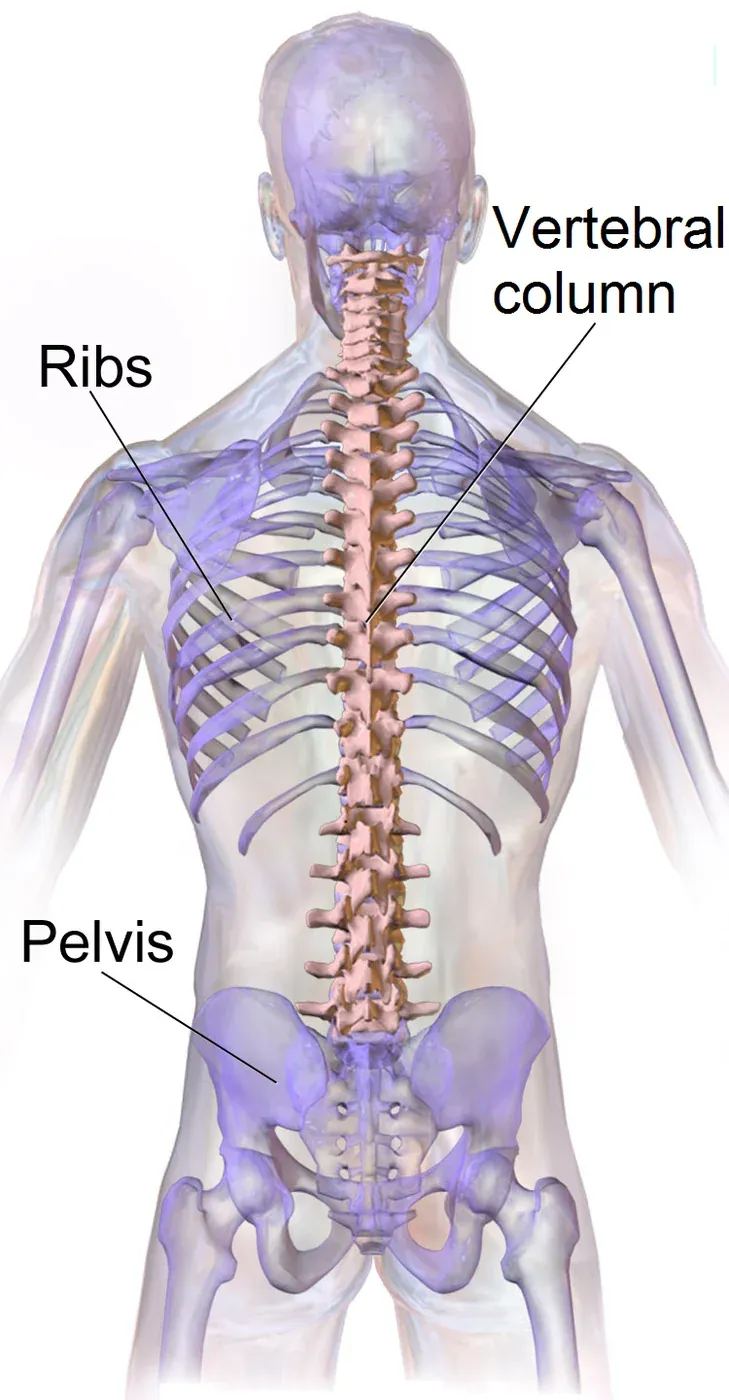
The vertebral column extends from the neck to the pelvis. Compression fractures most often affect vertebral bodies in the thoracic or lumbar spine. (Illustration: BruceBlaus, CC BY 3.0)
What Does a Spinal Compression Fracture Feel Like?
A painful compression fracture usually causes new, localized pain in the middle or lower back.
Common symptoms include:
- Sudden or rapidly worsening back pain
- Pain that becomes worse with standing or walking
- Severe pain when getting in or out of bed
- Pain when rolling over or changing positions
- Pain with bending or twisting
- Tenderness directly over the affected portion of the spine
- Improvement when lying down
- Difficulty performing normal daily activities
One of the biggest clues is often a sudden change in function.
A patient who was previously walking and functioning normally may suddenly struggle to stand long enough to shower, walk across the room, sleep comfortably, or dress without assistance.
How Do We Know if the Compression Fracture Is Causing the Pain?
This is one of the most important parts of the evaluation.
X-rays and CT scans can identify compression fractures, but they may not always tell us whether a fracture is new, old, or actively causing pain.
An MRI is often particularly helpful because a recent or still-healing fracture frequently shows bone marrow edema within the vertebral body.
However, imaging alone is not enough.
Many patients have older compression fractures visible on imaging that are not causing any symptoms.
The patient's history, examination, pain location, and imaging should all fit together.
One of the principles I emphasize in my practice is:
We do not treat an MRI. We treat the painful fracture that matches the patient's symptoms and examination.
Do All Compression Fractures Need Kyphoplasty?
No.
Many spinal compression fractures can be treated conservatively.
Treatment may include:
- Temporary activity modification
- Acetaminophen or anti-inflammatory medications when appropriate
- Short-term stronger pain medication in selected patients
- Bracing when appropriate
- Gradual return to activity
- Physical therapy after the acute pain begins to improve
- Evaluation and treatment for osteoporosis
If the patient's pain is manageable, they remain reasonably mobile, and symptoms are steadily improving, allowing the fracture to heal naturally may be the best approach.
Kyphoplasty becomes more attractive when the pain remains severe enough that the patient is losing mobility, independence, sleep, and the ability to perform basic daily activities.

When pain is manageable and mobility is preserved, conservative care and gradual rehabilitation may be the right first approach.
What Is Kyphoplasty?
Kyphoplasty is a minimally invasive procedure used to stabilize a painful vertebral compression fracture.
Using real-time fluoroscopic X-ray guidance, a small instrument is carefully advanced through the skin and into the fractured vertebra.
A specialized balloon is then placed inside the vertebral body and inflated to create a cavity and, in some cases, restore some of the lost vertebral height.
The balloon is removed and medical bone cement is carefully placed into the vertebra to stabilize the fracture.
The primary goal is not simply to make the X-ray look better.
The goal is to stabilize the broken bone so movement of the fracture produces less pain and the patient can begin moving normally again.
Does Kyphoplasty Actually Work?
For appropriately selected patients, there is meaningful evidence supporting balloon kyphoplasty.
One of the landmark studies was the FREE randomized controlled trial, which compared balloon kyphoplasty with nonsurgical management in patients with acute painful vertebral compression fractures.[1]
Patients who underwent kyphoplasty demonstrated greater improvement in physical function and quality of life during early recovery compared with nonsurgical treatment.
Longer-term follow-up from randomized studies has also demonstrated improvements in pain, disability, function, and quality-of-life measures.[2,3]
Clinical guidelines from organizations including the North American Spine Society recognize vertebral augmentation as a treatment option for appropriately selected patients with symptomatic osteoporotic vertebral compression fractures.[4]
This does not mean every compression fracture should be treated with kyphoplasty.
The evidence is most meaningful when the patient's symptoms, examination, imaging findings, pain severity, and functional limitations all point toward an active painful fracture.
What I See in My Own Practice
The research is important, but it also reflects much of what I see in my own patients.
I have treated many patients with painful vertebral compression fractures, and kyphoplasty is not perfect for every patient.
Some patients experience dramatic improvement. Others have a more gradual response, and occasionally a patient may have incomplete relief.
That is why careful patient selection is so important.
However, in appropriately selected patients, it is common in my practice to hear that their fracture pain is significantly improved within hours of the procedure.
Over the following several days, many patients also notice meaningful improvements in function.
They may be able to:
- Get out of bed much more comfortably
- Stand and walk longer
- Sleep better
- Dress and shower with less difficulty
- Reduce their reliance on pain medication
- Return to normal daily activities
Some of the most rewarding follow-up visits are patients who initially arrived barely able to walk because of pain and return several days later moving much more comfortably.
I never promise that every patient will experience that degree of improvement.
But when the symptoms, examination, and MRI all point toward an active painful compression fracture, relatively rapid improvements in pain and mobility are something I commonly see.
Why Does Getting Someone Moving Again Matter?
This is one of the most important considerations, especially in older adults.
Consider two patients with similar compression fractures.
The first patient has moderate pain but can still walk around the house, sleep reasonably well, and perform most daily activities. Each week, the pain is improving.
That patient may do very well with conservative treatment.
The second patient may have such severe pain that getting out of bed is extremely difficult. They stop walking, sleep poorly, require increasing pain medication, and begin depending on family members for basic activities.
Those are very different clinical situations.
With the second patient, I am not only asking:
Will this fracture eventually heal?
I am also asking:
What is going to happen to this patient's strength, mobility, independence, and overall health while we wait?
Prolonged inactivity can quickly lead to weakness and deconditioning, particularly in older adults.
For some patients, restoring mobility is therefore one of the most important goals of treatment.

For many patients, the meaningful outcome is not only a lower pain score—it is regaining safe mobility, independence, and daily function.
When Do I Consider Kyphoplasty?
There is no single rule that applies to every patient.
I become more interested in kyphoplasty when several factors line up:
- The fracture is relatively recent or remains active on imaging
- MRI demonstrates findings consistent with an active fracture
- The location of the fracture matches the patient's pain
- Pain is moderate to severe
- Standing and walking are significantly limited
- Getting in and out of bed is extremely painful
- Sleep is significantly affected
- Basic daily activities have become difficult
- Conservative treatment is not adequately controlling symptoms
- The patient is becoming progressively less active because of pain
One finding by itself usually is not enough.
The best candidates are patients in whom the symptoms, examination, imaging, and functional limitations all fit together.
Do Patients Have to Wait Weeks or Months Before Kyphoplasty?
Not necessarily.
Historically, some patients were told that they had to wait several weeks before vertebral augmentation could even be considered.
The decision is more individualized than that.
Evidence examining the timing of balloon kyphoplasty suggests that earlier treatment of appropriately selected symptomatic fractures may result in better pain outcomes than significantly delayed treatment.[5]
That does not mean every new compression fracture should immediately undergo kyphoplasty.
A patient who is improving, sleeping reasonably well, and remaining mobile may never need a procedure.
However, a patient with a clearly active fracture who is experiencing severe pain and rapidly losing mobility does not necessarily need to suffer for months simply to prove that conservative treatment has failed.
Timing should be based on the individual patient's pain severity, imaging findings, functional impairment, overall medical condition, and trajectory of recovery.
What Are the Risks of Kyphoplasty?
Kyphoplasty is minimally invasive, but no procedure is completely without risk.
Potential risks include:
- Bleeding
- Infection
- Cement leakage outside the vertebral body
- Injury to a nerve or surrounding structure
- Medication or anesthesia-related complications
- Failure to adequately improve the pain
- Additional vertebral fractures in the future
Serious complications are uncommon, but they are possible and should be discussed before treatment.
What Happens After Kyphoplasty?
Kyphoplasty is generally performed through very small skin punctures using fluoroscopic X-ray guidance.
Most patients are able to go home the same day.
Patients are usually encouraged to gradually increase their activity as tolerated.
Some patients notice meaningful improvement within hours of the procedure. Others notice the biggest change over the following several days.
The goal is not simply to reduce a number on a pain scale.
The more important question is whether the patient can begin doing things again that the fracture had prevented them from doing.
- Can they walk more comfortably?
- Can they get out of bed?
- Can they sleep?
- Can they shower and get dressed?
- Can they begin returning to normal life?
Those functional improvements are often the most meaningful measure of success.
Kyphoplasty Does Not Treat Osteoporosis
This is an extremely important point.
Kyphoplasty treats the fracture.
It does not treat the underlying osteoporosis that may have caused it.
A vertebral compression fracture after relatively minor trauma can be a major warning sign that a patient's bones are weaker than they should be.
Patients with a fragility fracture should generally be evaluated for osteoporosis or other causes of weakened bone.
Depending on the patient, this may include:
- Bone density testing
- Laboratory evaluation
- Calcium and vitamin D assessment
- Osteoporosis medication
- Fall-prevention strategies
- Exercise and strengthening recommendations
Treating the fracture without addressing the underlying bone health means missing an important part of the problem.
Compression Fracture and Kyphoplasty Treatment in Utah
At Horizon Spine & Pain of Utah, we evaluate and treat painful vertebral compression fractures for patients throughout Utah County and the surrounding region.
Our Payson clinic is convenient for patients from communities including:
- Payson
- Spanish Fork
- Springville
- Mapleton
- Santaquin
- Provo
- Orem
- Salem
- Nephi
- Southern Utah County
We also evaluate patients who travel from the greater Salt Lake region for specialized interventional spine and pain treatment.
Treatment may range from conservative care to minimally invasive vertebral augmentation, including kyphoplasty, depending on the patient's symptoms, imaging findings, overall health, and functional limitations.
Our goal is not to perform a procedure simply because a compression fracture appears on an MRI.
Our goal is to identify the true source of the pain, determine how much that pain is affecting the patient's quality of life and mobility, and choose the least invasive treatment that can safely help them return to normal activity.
The Bottom Line
Most vertebral compression fractures do not automatically require kyphoplasty.
If pain is manageable, mobility is preserved, and symptoms are steadily improving, conservative treatment may be entirely appropriate.
But for the right patient—particularly someone with a recent or active spinal compression fracture causing severe focal pain and substantial difficulty walking, standing, sleeping, or performing basic daily activities—kyphoplasty can be a valuable minimally invasive treatment option.
The most important question is not:
Does the MRI show a compression fracture?
It is:
Is this fracture causing the patient's pain, and is that pain preventing them from functioning and recovering?
That is ultimately the decision we try to make for each patient.
Dr. Devan Partridge, DO — Horizon Spine & Pain of Utah
Pain Relief Is On The Horizon — Driven by Evidence, Delivered with Compassion.
References
- [1] Wardlaw D, Cummings SR, Van Meirhaeghe J, et al. Efficacy and safety of balloon kyphoplasty compared with non-surgical care for vertebral compression fracture (FREE): a randomized controlled trial. The Lancet. 2009;373:1016-1024.
- [2] Boonen S, Van Meirhaeghe J, Bastian L, et al. Balloon kyphoplasty for the treatment of acute vertebral compression fractures: 2-year results from a randomized trial. Journal of Bone and Mineral Research. 2011;26(7):1627-1637.
- [3] Van Meirhaeghe J, Bastian L, Boonen S, et al. A randomized trial of balloon kyphoplasty and nonsurgical management for treating acute vertebral compression fractures. Spine. 2013.
- [4] North American Spine Society. Diagnosis and Treatment of Adults with Osteoporotic Vertebral Compression Fractures: Evidence-Based Clinical Guideline.
- [5] Khan MA, et al. The effect of time to balloon kyphoplasty on osteoporotic vertebral compression fractures: a systematic review with meta-analysis. North American Spine Society Journal. 2025.