
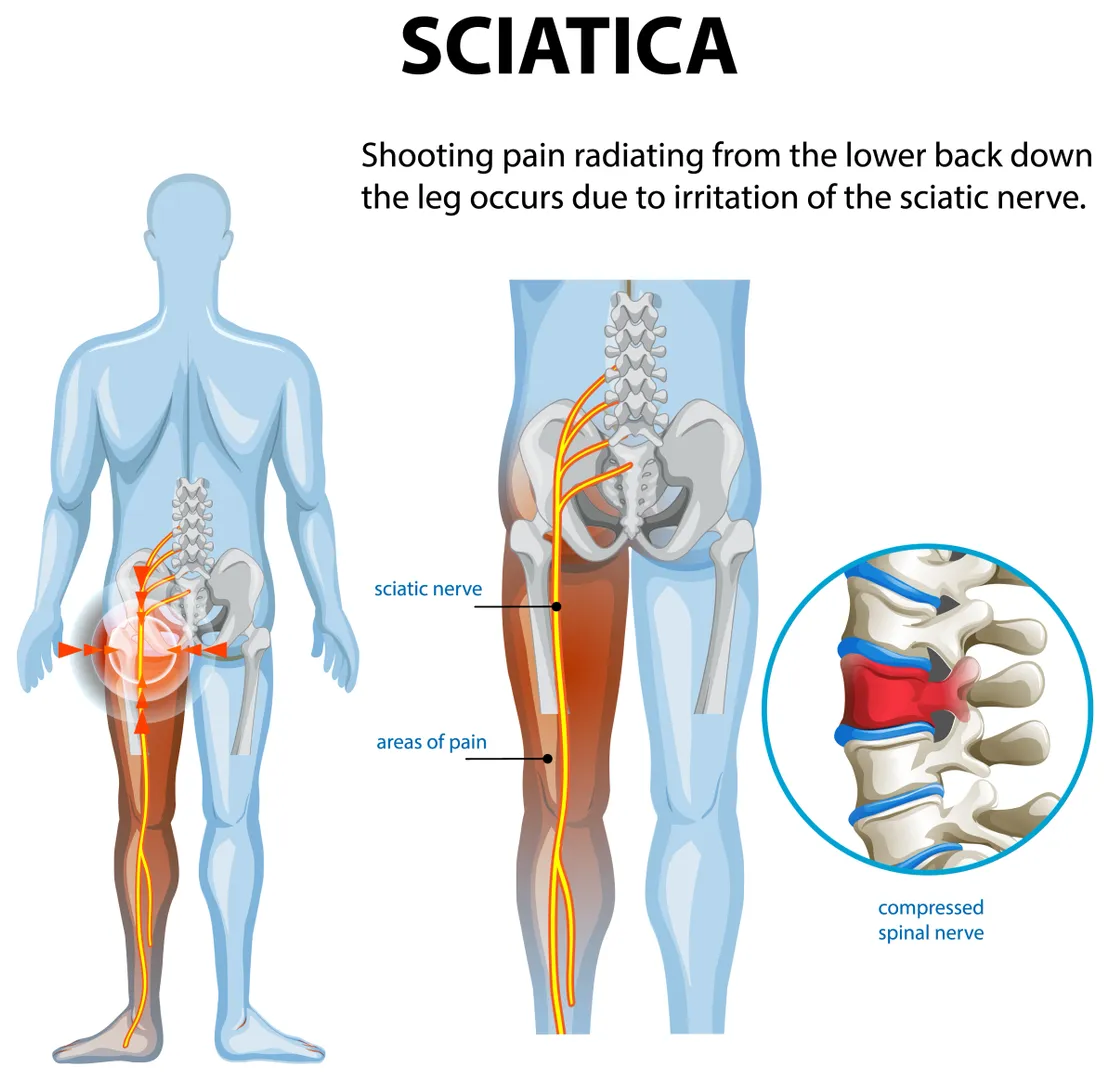
Sciatica is one of the most common and misunderstood pain conditions. That shooting pain down your leg isn't just "sciatica"—it's lumbar radiculopathy, a specific medical condition with clear causes and evidence-based treatments.
Sciatica vs. Lumbar Radiculopathy: What's the Difference
"Sciatica" is a lay term for pain radiating down the buttock, thigh, or leg. Medically, the correct term is lumbar radiculopathy—which refers to compression or irritation of a spinal nerve root, typically at L4, L5, or S1. This nerve irritation causes:
- Burning, shooting, or electric pain down the leg
- Numbness or tingling
- Muscle weakness
- Reflex changes
The Most Common Causes of Sciatica (Lumbar Radiculopathy)
- Herniated Disc: Disc bulges or herniations are the leading cause in younger and middle-aged adults.
- Foraminal Stenosis: A very common cause in older adults. As discs degenerate and arthritis progresses, the foramina where nerve roots exit become narrowed—pinching the nerves.
- Degenerative Disc Disease: Disc height loss leads to narrowing of nerve pathways and chronic inflammation.
- Spondylolisthesis: One vertebra slips over another, compressing the nerve root.
- Piriformis Syndrome (Rare): In some cases, the sciatic nerve is compressed by the piriformis muscle deep in the buttock. This is much less common than spinal causes.
Can Sciatica Heal Naturally?
Yes—many cases of acute lumbar radiculopathy improve with conservative treatment.
Physical Therapy:
- Core stabilization and lumbar mechanics
- McKenzie extension-based exercises
- Nerve glides and neural mobilization
- Posture and ergonomics training
Chiropractic Care:
- Spinal manipulation and mobilization
- Temporarily reduces tension and stiffness in the lumbar spine
Medication Management:
- NSAIDs: first-line anti-inflammatory
- Oral corticosteroids: short-term relief
- Neuropathic agents: gabapentin, pregabalin (mixed results)
- Muscle relaxants: helpful in spasm-dominant cases
- Short-term opioids: reserved for severe, disabling pain
When Injections Help
Image-guided spinal injections can provide significant relief.
Epidural Steroid Injections (ESIs):
- Reduce inflammation around affected nerve
- Best for disc herniation and foraminal stenosis
- Delivered via interlaminar, caudal, or transforaminal approach
Selective Nerve Root Blocks (SNRBs):
- Target a single nerve root for diagnostic and therapeutic use
Regenerative and Emerging Therapies
Platelet-Rich Plasma (PRP):
- Injected near nerves or into discs to promote healing
- Contains growth factors like PDGF, TGF-β, VEGF
BPC-157 (Body Protection Compound):
- Synthetic peptide that enhances nerve regeneration and reduces inflammation
- Stimulates angiogenesis and tissue remodeling
- Based on animal studies, used off-label in regenerative medicine
Minimally Invasive Disc Decompression
Options include:
- Percutaneous discectomy: small tools remove disc material under imaging
- Endoscopic discectomy: camera-assisted removal through Kambin's triangle
- Laser-assisted decompression: less common in the U.S.
When to Consider Surgery
Surgery is appropriate when:
- Progressive neurological deficit
- Imaging and symptoms align
- Failure of conservative + interventional therapies
Options include microdiscectomy, laminectomy, foraminotomy, and fusion.
What If It Becomes Chronic?
Chronic radiculopathy may require neuromodulation.
Spinal Cord Stimulation (SCS):
- FDA-approved for chronic radicular pain
- Interrupts pain signaling with electrical pulses
- Includes high-frequency, burst, and closed-loop systems
You Don't Have to Live with Sciatica
Whether it's a disc herniation, foraminal stenosis, or rare piriformis syndrome, sciatica is treatable.
At Horizon Spine & Pain of Utah, we provide:
- Comprehensive diagnosis
- Physical therapy and rehab
- Precision injections and biologics
- Minimally invasive decompression
- Spinal cord stimulation for chronic pain
Visit Horizon Spine & Pain of Utah – Your Sciatica Experts
Located in Payson, Utah, serving Spanish Fork, Santaquin, Salem, and surrounding communities.
- Phone: 385-298-1008
- Email: frontdesk@horizonpainutah.com
- Website: www.horizonpainutah.com